The Difference Between Tagged Equipment and Tested Equipment: AS/NZS 3760 Compliance Explained
When you arrange commercial electrical Test and Tagging for your workplace, it’s easy to assume every provider delivers the same service: inspect a lead or device, run a test, and attach a tag.
But behind the scenes, the depth of testing can vary significantly.
While a basic check might tick a temporary box on paper, true compliance under Australian Standard AS/NZS 3760 requires specific testing methods-especially when it comes to energised earth leakage testing on modern commercial equipment, industrial machinery, and workplace appliances.
At Shock Busters, we believe in full transparency for every business we serve.
Whether you operate in a bustling metro center or a regional hub, you aren’t just paying for a Tag; you’re paying to make sure the devices in your workplace are genuinely safe, your legal liability is managed, and your equipment meets strict SafeWork NSW / WorkSafe QLD / Queensland Electrical Safety Office(ESO) standards.
1. “What’s All That Equipment? The Last Provider Didn’t Need Mains Power…”
We regularly hear this exact feedback from business owners, practice managers, workshop supervisors, and facility managers (on a first visit) across Tweed Heads, Ballina, Lismore, Coffs Harbour, Tamworth, Goulburn, the ACT, Brisbane, and the Sunshine Coast:
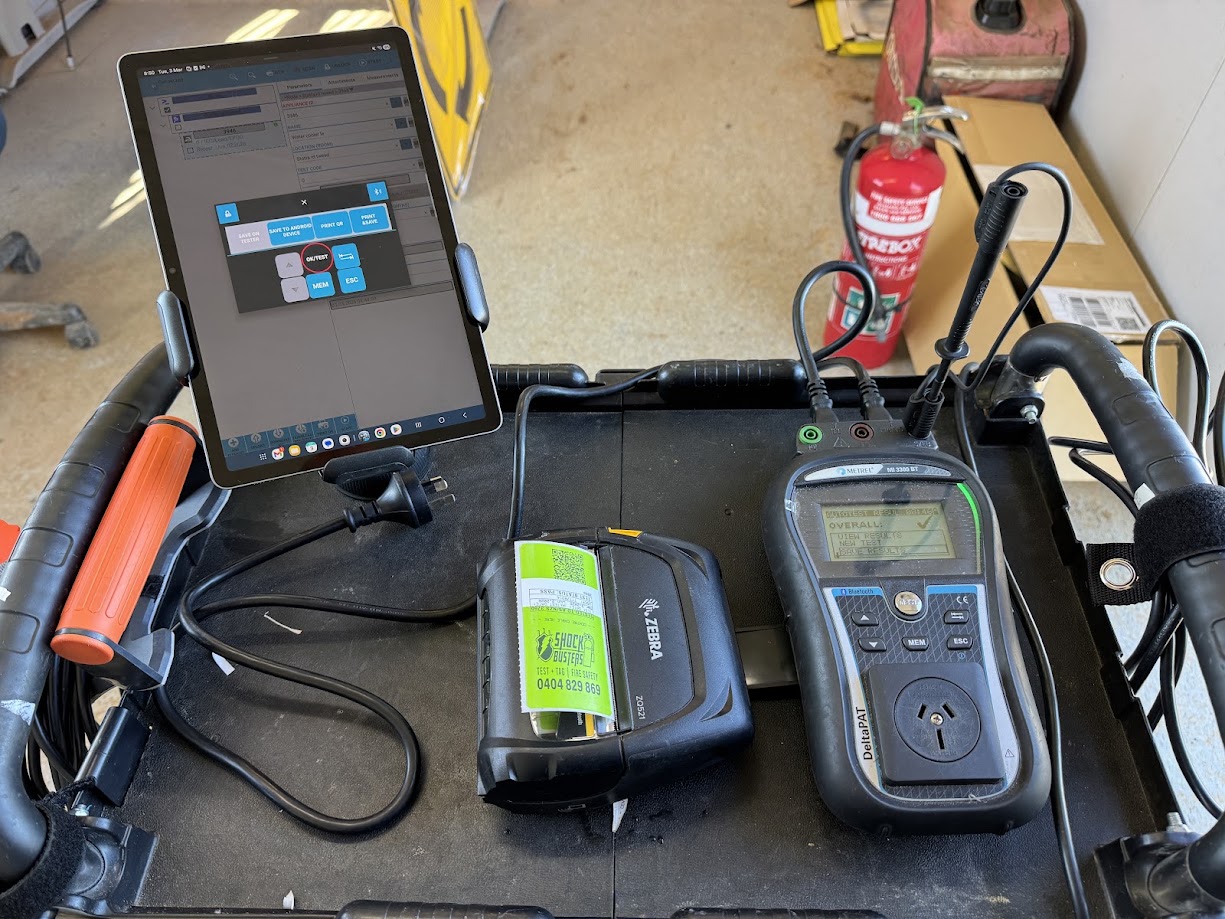
“What’s all that equipment you’ve set up”? “The last provider didn’t need access to mains power to test” – “they were in and out in no time!”
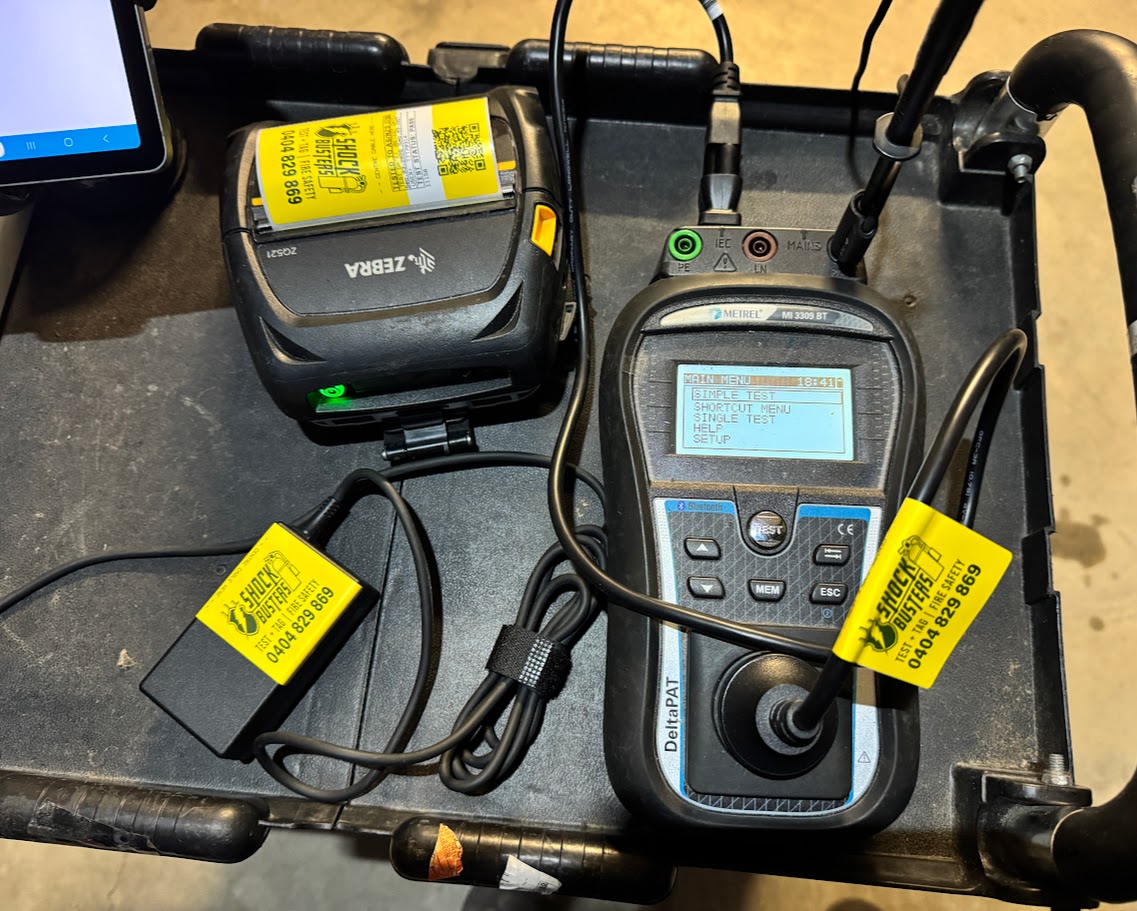
When a customer notices the difference in our setup, it’s usually their first realization that comprehensive AS/NZS 3760 testing requires dedicated, commercial-grade gear – and time.
While basic battery-powered handheld devices can check simple insulation, if they are not plugged into mains power, they cannot perform a true Earth Leakage Current test.
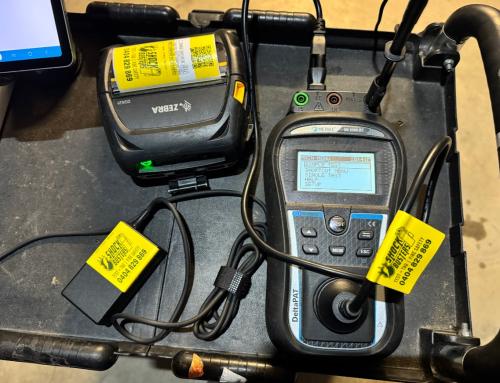
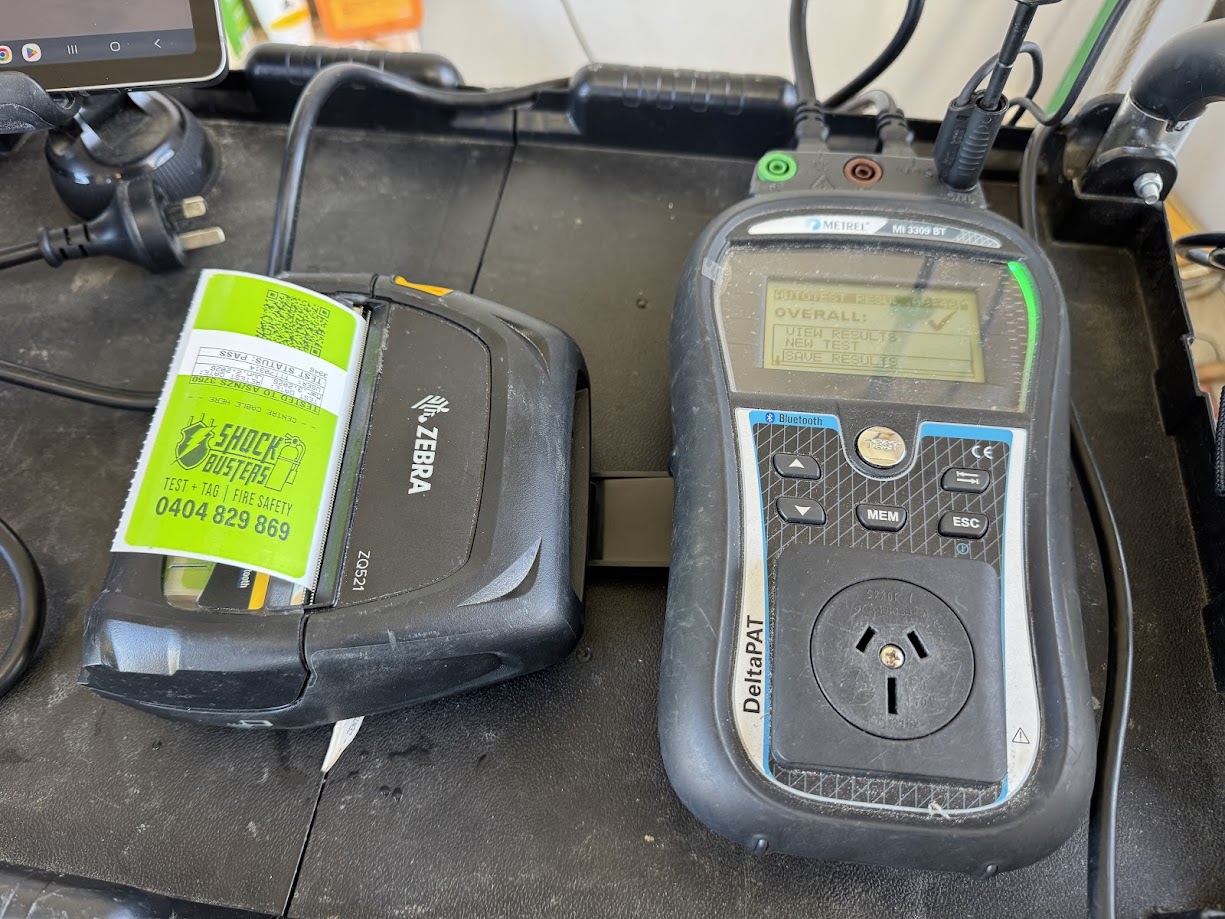
To test modern electronic appliances properly, the equipment must be plugged into 240V mains power so its internal circuits are energised. Bringing commercial Metrel Portable Appliance Testing (PAT) gear and a dedicated thermal printer allows us to capture live measurements and issue heavy-duty, barcode-linked compliance tags on the spot – delivering thorough, fully documented compliance that truly protects your workplace
2. The Math of a Real Test: How Many Items Can Actually Be Tested Per Hour?
Let’s talk real numbers. Doing a thorough, compliant electrical Test and Tag inspection isn’t just a quick “tag and run” job.
A qualified Test and Tag technician has to:
-
Locate, untangle, and inspect the full length of the cord – plug and device for physical damage or wear.
-
Attach testing leads and run the Portable Appliance Tester (PAT) sequence.
-
Plug into 240V mains power to run energised leakage tests where required.
-
Print an automated compliance tag generated directly from live test data via Bluetooth.
-
Identify, describe, and catalogue the asset, so the exact numeric test values captured by the tester are correctly linked to that item in your digital asset register.
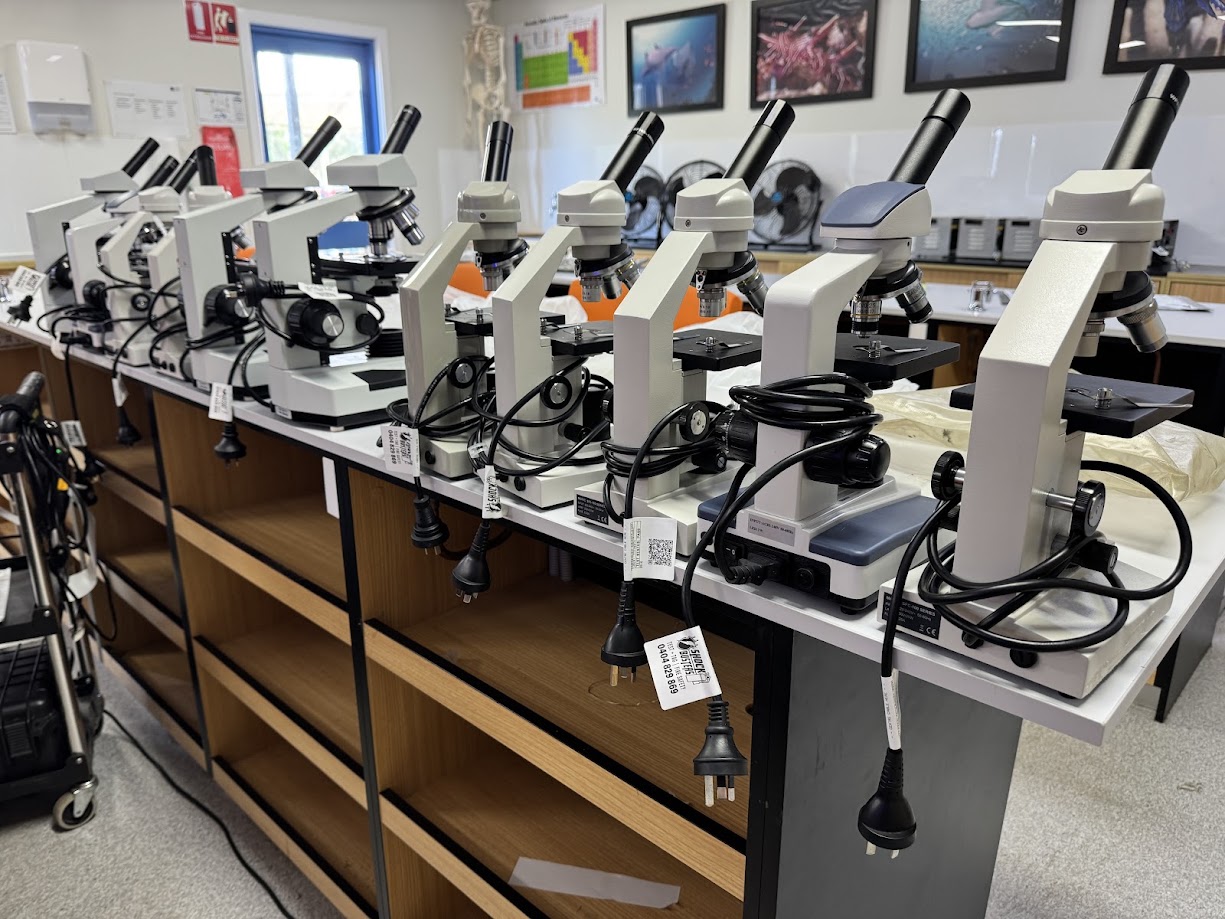
In a standard business – commercial, medical, industrial, or agricultural environment – where gear needs to be moved around, unstacked, or unplugged safely – a realistic pace for a thorough, single technician is about 20 to 25 items per hour.
Even on an intensive 10-hour run, 200 to 250 items is a realistic maximum for a single technician doing genuine, non-stop quality testing.
A provider claiming a single technician can process 300 to 400+ items in a single 10 hr shift without extra hands is a major red flag. Proper AS/NZS 3760 compliance takes time, and those numbers usually indicate that essential testing steps are being cut.
📞 Call Southern NSW & ACT (0402 120 637)
📞 Call Northern NSW & SE QLD (0404 829 869)
📅 Book Online
3. Why Earth Leakage Testing Requires Mains Power Under AS/NZS 3760
Under AS/NZS 3760, Earth Leakage Testing is the essential check for verifying that an operating appliance won’t shock a user or trip safety switches. It measures the tiny, hazardous currents leaking from internal components while the device is actively running.
Why 240V Mains Power is Mandatory for Class I Equipment
While modern Portable Appliance Testers (PAT) use internal batteries for basic insulation checks on simple tools, executing a compliant leakage current test on electronically switched equipment requires the tester to be connected to 240V mains power.
When an electronically controlled appliance – such as a commercial espresso machine, soft-start angle grinder, office rack server, or digital combi oven – is unplugged, its internal power switches, relays, and safety contactors remain open
Testing an electronically switched appliance solely on battery power or without connecting to a 240V supply only checks the flexible lead up to the switch – leaving internal heating elements, circuit boards, and motor windings completely unpowered and untested!
This limitation also applies to handheld battery units running low-voltage (~40V AC) “substitute leakage” tests.
Because reduced battery voltage cannot activate internal control boards or close electronic switches, substitute leakage testing fails to reach downstream circuits.
This requirement is explicitly mandated in AS/NZS 3760:2022 (Clause 2.4.3.2):
“If the equipment must be energised to close or operate a switching device in order to test the insulation, then the leakage current test in accordance with Appendix E shall be performed.”
Because Appendix E mandates nominal mains operating voltage (240V AC) to energize the unit, static DC insulation tests and low-voltage substitute leakage tests do not meet compliance for electronically switched gear.
If a provider inspects your electronically controlled equipment without connecting their PAT apparatus to live mains power in these instances, those active internal circuits are missing the mandatory safety check required under Australian standards.
4. Four Technical Shortcut Areas to Watch For
Beyond skipping essential earth leakage tests, high-speed testing routines often rely on subtle technical shortcuts that leave your site exposed during a SafeWork NSW, WorkSafe QLD, or WorkSafe ACT audit:
-
Uncalibrated PAT Machines: AS/NZS 3760 requires testing equipment to be calibrated annually. High-speed operators sometimes run uncalibrated gear that outputs inaccurate readings or registers false “Passes” on dangerous tools.
-
RCD Safety Switch Trip-Time Measurements: While push-button checks are a required 6-monthly test to confirm the mechanical latch moves, AS/NZS 3760 also mandates operating trip-time testing. Using a dedicated RCD tester, we measure the exact disconnection speed in milliseconds to guarantee the safety switch will cut power fast enough under a real fault to prevent electrocution.
-
Pre-Written Tags vs. Live Data-Linked Printing: Under AS/NZS 3760, compliance tags can be handwritten, pre-printed, or automated.
Having pre-printed company details or logos on tag stock is completely standard practice – the risk occurs when technicians pre-write test dates and “PASS” statuses before the testing is performed.
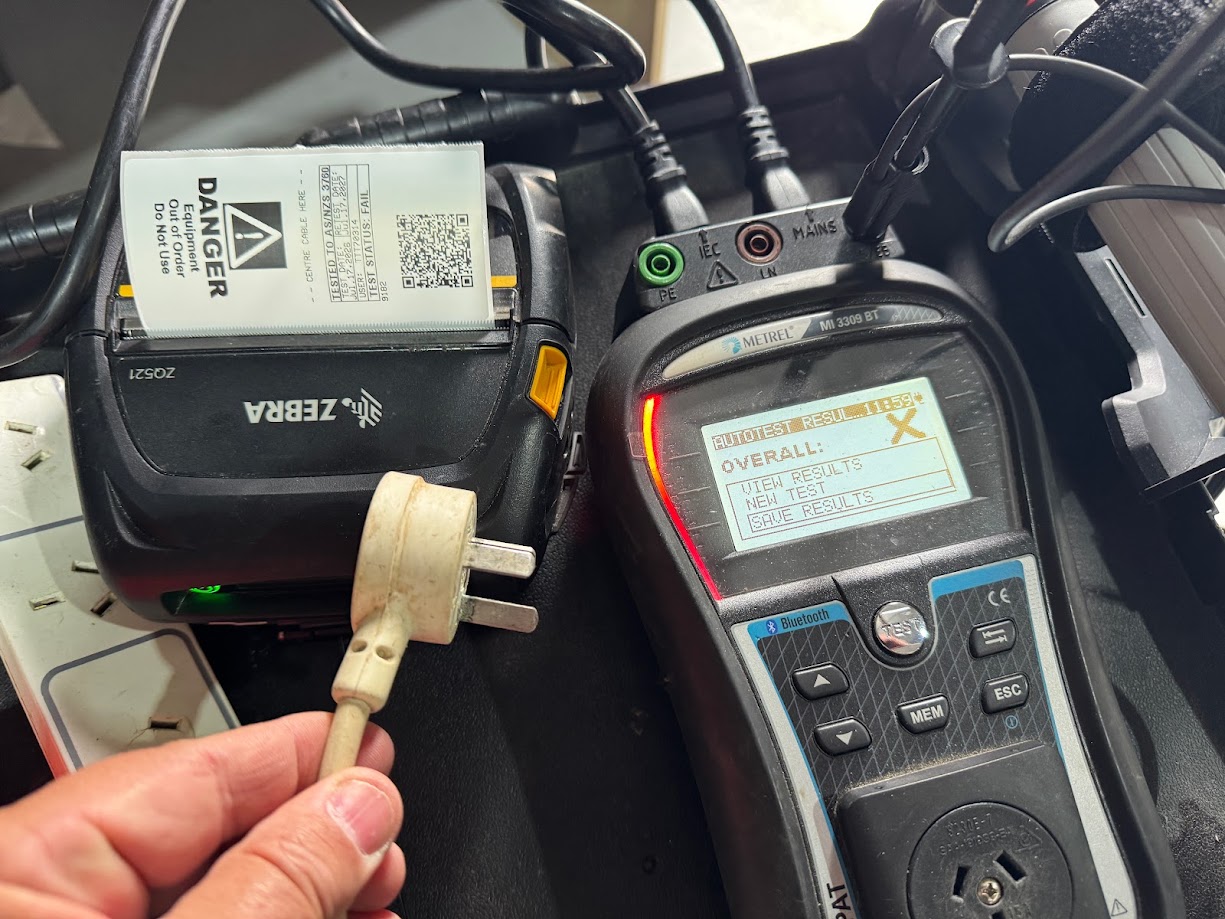
Writing out sheets of tags in the van to slap onto equipment without running a live sequence leaves your team at risk and site compliance vulnerable in an audit.At Shock Busters, we use Bluetooth-linked thermal tag printers connected directly to our Metrel PAT units.
A heavy-duty tag is only printed on the spot AFTER the machine logs a passing test result, eliminating unreadable handwriting, ensuring precise barcode asset tracking, and guaranteeing that no item is ever “pre-tagged.” -
Misclassifying Equipment Class: Shortcut-heavy testing routines often test earthed Class I tools as double-insulated Class II devices simply to skip the essential Earth Leakage and Earth Continuity tests to save time. (Pro Tip: Look at the rating label on your gear—Class II double-insulated equipment will almost always display the double-square symbol.
If a tool has a 3-pin earthed plug or metal casing and lacks that double-square icon, it’s usually a Class I device and MUST undergo full Earth Leakage testing under live power!)
📞 Call Southern NSW & ACT (0402 120 637)
📞 Call Northern NSW & SE QLD (0404 829 869)
📅 Book Online
5. Reporting & Proof: Can Your Provider Show You Real Numbers?
Want to know if your current provider is actually running proper AS/NZS 3760 tests? Ask to see the live test readings.
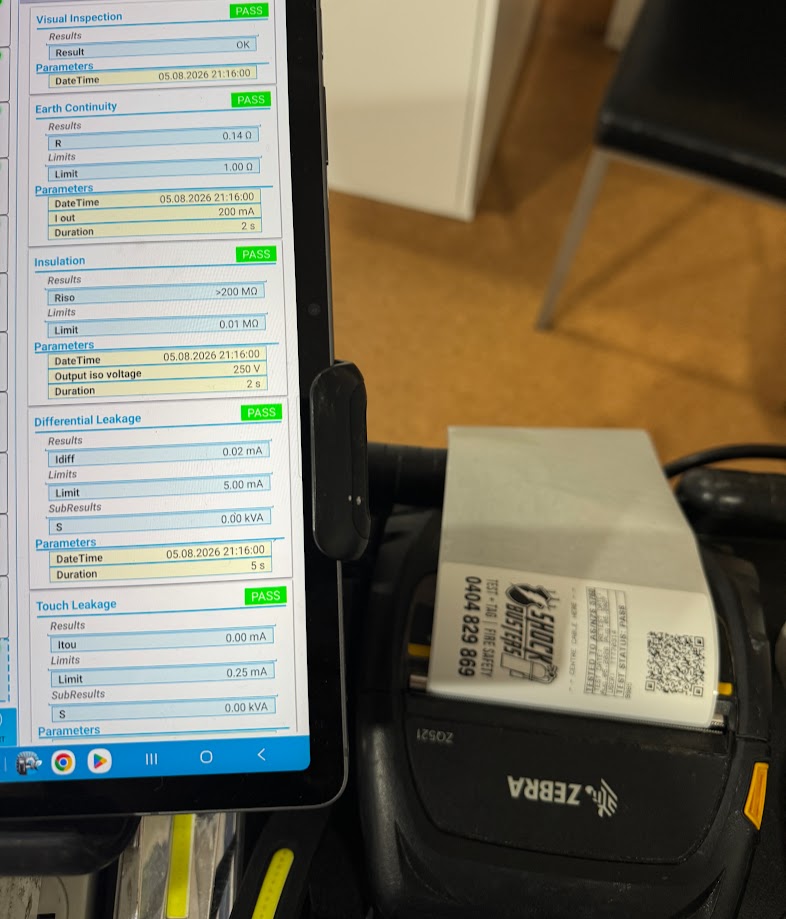
When a qualified technician tests an earthed tool or appliance with modern PAT equipment, the machine measures exact physical properties – like Earth Bond resistance in Ohms , Insulation Resistance in Megohms, and Leakage Current in Milliamps.
A reputable commercial Test and Tag provider can easily demonstrate compliance on the spot:
-
The On-The-Spot Check: At any point during a job, your technician should be able to turn the device screen toward you and show you the exact live test measurements for an item.
-
Executive Summary Reports: For routine workplace health and safety (WHS) management, you get a clean, easy-to-read summary showing total pass/fail counts and re-test dates.
-
Detailed Asset Register Reports On Request: Behind every summary, a full digital asset report with every single item’s numerical test results is able to be provided or stored safely on file, readily available whenever SafeWork NSW, WorkSafe QLD, WorkSafe ACT, or your commercial insurer requests it.
Quality Electrical Safety Testing That Fits Your Budget
High-tech, thorough testing doesn’t have to come with a massive price tag.
At Shock Busters, we bring trusted electrical safety testing across all of NSW, regional communities, the ACT, and South QLD, ensuring local businesses get complete peace of mind without overpaying.
We don’t rush or cut corners. We take the time required to inspect carefully, plug into mains power for genuine earth leakage testing, print heavy-duty tags directly from live Metrel test data on the spot, and maintain full digital asset reports – all at rates that are still shockingly affordable.
Frequently Asked Questions About AS/NZS 3760 Compliance
Q: How often does workplace equipment need to be tested and tagged across NSW, ACT, and QLD?
A: Test frequencies depend on the working environment under AS/NZS 3760 Table 2.4.
Construction and demolition sites require 3-monthly testing.
Factories, workshops, commercial kitchens and manufacturing sites require 6-monthly testing.
Office spaces, retail outlets, and general business’s typically require 12-monthly depending on the equipment type and risk review.
Q: Do you service regional commercial premises and multi-site accounts across NSW, ACT, and South QLD?
A: Absolutely. Shock Busters proudly services regional businesses, agricultural facilities, schools, clinics, and industrial sites across every region of NSW, the ACT, and South QLD, delivering trusted Test and Tag Inspections and digital reporting for easy compliance management.
Q: Can Test and Tagging be performed after hours to avoid business downtime?
A: Yes. We offer flexible scheduling – including early morning, evening, and weekend site visits- so your staff and operations remain completely uninterrupted.
Key Regional Service Hubs We Cover
We proudly provide full AS/NZS 3760 Electrical Test and Tag services across all of New South Wales, the ACT, and South East Queensland, with dedicated coverage across key regional hubs:
📍 Northern NSW & Mid North Coast
-
Tweed Coast & Border: Tweed Heads, Kingscliff, Murwillumbah, Pottsville
-
Northern Rivers: Byron Bay, Ballina, Lismore, Casino, Kyogle
-
Clarence Valley & Mid North Coast: Grafton, Coffs Harbour, Port Macquarie, Kempsey, Nambucca Heads
📍 Inland & Regional NSW
-
New England & North West: Tamworth, Armidale, Moree, Inverell, Gunnedah
-
Central West & Riverina: Dubbo, Orange, Bathurst, Mudgee, Wagga Wagga, Griffith, Albury-Wodonga
📍 Southern Regional NSW, South Coast & ACT
-
Southern Tablelands & Monaro: Goulburn, Queanbeyan, Yass, Crookwell, Bowral, Cooma, Snowy Monaro
-
South Coast & Illawarra: Wollongong, Shellharbour, Nowra, Ulladulla, Batemans Bay, Bega
-
Australian Capital Territory: Canberra Metro & Surrounds
📍 South East Queensland (South QLD):
QLD Electrical Contractor Licence Number: 1510173
-
Gold Coast & Hinterland: Coolangatta, Robina, Southport, Nerang, Mount Tamborine
-
Greater Brisbane, Sunshine Coast & Scenic Rim: Logan, Ipswich, Beaudesert, Brisbane Metro, Sunshine Coast, Moreton Bay
Don’t see your town listed above?
No problem. We regularly travel throughout regional NSW, the ACT, and South QLD.
Contact Shock Busters today to check our upcoming route schedule or request a site visit.
Need Compliant Electrical Safety Testing in Your Region?
Contact your nearest Shock Busters team today to schedule your AS/NZS 3760 compliance audit or request a custom after-hours service
(click the direct links below to call or book online):
📞 Call Southern NSW & ACT (0402 120 637)
📞 Call Northern NSW & SE QLD (0404 829 869)
📅 Book Online